From Prompts to Autonomous Systems: How Enterprise AI Is Moving Beyond Chatbots
Explore the evolution from prompts to enterprise AI agents. Discover how autonomous systems plan, act, and deliver, moving beyond chatbots.
 Parathan Thiyagalingam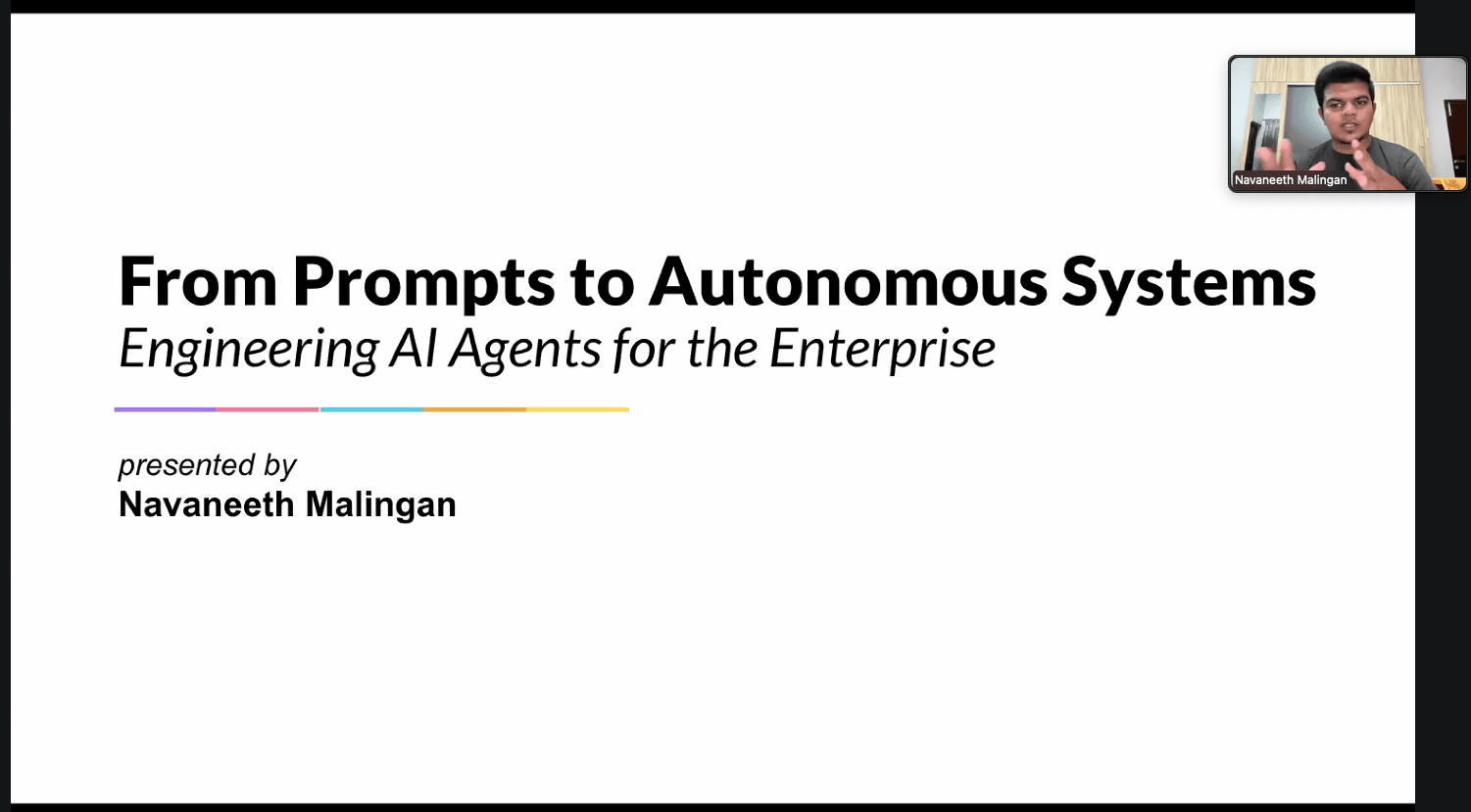
AI didn’t suddenly wake up one day and become “agentic”.
What we’re seeing now as autonomous systems that can plan, act, and operate across tools are the result of a long, quiet evolution in how we build intelligence into software.
The biggest shift isn’t better prompts or bigger models. It’s the move from standalone models to agent-based systems.
That realisation was sharpened for me during a recent session by Nunnari Academy, presented by Navaneeth Malingan, on "From Prompts to Autonomous Systems: Engineering AI Agents for the Enterprise".
This post builds on that foundation, combined with my own perspective on where this shift is actually leading.
The Progression Most AI Content Skips
Most AI discussions jump straight from “LLMs are powerful” to “agents will run everything.”
What’s usually missing is the connective tissue. the why.
A useful way to think about the progression is:
CNNs / RNNs → GPT → Prompts → Workflows → Agents
Early machine learning focused on training models to make decisions from data. If you had enough labelled examples, you could classify, predict, or optimise. This worked well for structured problems but quickly broke down when faced with language, sequences, or context-heavy tasks.
Deep learning pushed those boundaries. Neural networks, RNNs, GANs, and eventually transformers allowed systems to handle unstructured and sequential data more effectively.
But the real inflection point came with GPT-style models.
Why GPT Was a Structural Break, Not an Incremental Upgrade
Before transformers, most AI systems were descriptive and narrow. They classified inputs, answered yes/no questions, or followed predefined logic.
GPT models changed this by learning the structure of language itself. They are not task-specific. Instead of training a new model for every problem, the same model can be adapted using prompts, examples, and context.
This unlocked:
- Zero-shot and few-shot learning
- Reasoning via Chain-of-Thought (popularized in 2022)
- Domain grounding through RAG without retraining
At that point, LLMs stopped being just text generators. They became general reasoning components.
And once you have reasoning, the next step is action.
From Answers to Outcomes: Chatbots, Co-pilots, and Agents
A simple but powerful distinction from the session captured this well:
- Chatbot → You ask, it answers (reactive)
- Co-pilot → You work, it assists (collaborative)
- Agent → You delegate, it delivers (autonomous)
Agents don’t just respond to inputs. They plan steps, invoke tools, observe outcomes, and adjust behaviour until a goal is achieved.
This is the difference between AI that talks and AI that does.
What a GenAI Agent Actually Is
A GenAI agent isn’t a single model. It’s a system.
At its core, an agent combines:
- A reasoning loop (Think → Plan → Act → Reflect)
- A model (LLM)
- Tools (APIs, databases, enterprise systems)
- Memory (context across steps and time)
Agents are usually task-specific, but they’re built on general-purpose models. The intelligence comes from the LLM, but the reliability comes from everything wrapped around it.
That distinction becomes critical in enterprise settings.
SaaS Is Quietly Becoming “Service as Software”
Traditional SaaS (Software as a Service) is still human-centric. Software sits between business users and customers, and people do most of the execution.
What’s emerging now is SaaS 2.0: Service as Software.
Here, AI agents don’t just support workflows. They are the workflow. The software doesn’t help someone do the job; it performs the job itself.
This shift helps explain why roughly two-thirds of recent Y Combinator companies are building agent-based products. Agents change the unit economics by replacing manual execution with autonomous systems.
But turning this into something enterprises can trust is where things get hard.
What “Enterprise-Grade” Really Means for AI Agents
Enterprise AI agents aren’t demos.
They’re expected to deliver:
- Reliability
- Scalability
- Security
- Privacy
- Measurable ROI
In practice, “enterprise-grade” also means:
- Compliance and auditability
- Private deployments (on-prem or VPC)
- Multi-tenant architectures
- Clear SLAs
This is the point where many promising agent prototypes fail to cross the gap into production.
Where Building Agents Gets Difficult (and Interesting)
Once agents move beyond demos, the challenges stop being theoretical and start being very operational.
Tool Integration
Every tool an agent can use is a new failure point. Clear tool definitions, strict validation, and starting with a small, well-defined toolset matter far more than tool count.
Reasoning and Decision-Making
LLMs are probabilistic. Predictable agent behaviour requires structured prompting (such as ReAct), low temperature settings (often 0–0.3), guardrails, and extensive scenario testing.
Multi-Step Workflows
Agents must maintain state, handle interruptions, and manage dependencies across steps. This demands robust state management, fallback paths, and comprehensive logging.
Hallucinations and Accuracy
In enterprise contexts, plausible-but-wrong answers are dangerous. Grounding, citations, structured outputs (like JSON schemas), confidence thresholds, and human review for critical decisions are essential.
Performance at Scale
At scale, failures cascade. Circuit breakers, retries with backoff, caching, queue management, and LLMOps monitoring aren’t optimisations; they’re table stakes.
The Takeaway That Stuck With Me
AI agents are not just smarter chatbots. They are autonomous software systems that reason, plan, and act across the enterprise. And the hardest part isn’t choosing the right model.
It’s engineering the system around the model, like the tools, guardrails, workflows, and failure handling that make autonomy safe and valuable. That’s where the real work is. And that’s where the real differentiation will come from.
If you’re building agents today:
- Start small.
- Assume failure.
- Treat LLMs as probabilistic components, not deterministic logic.
That mindset shift alone will save you months.
-----------------
Nunnari Academy is conducting a weekend course on Introducing Generative AI & Agentic AI.
Check their LinkedIn for more details.