Beyond the Vulnerability Backlog - Why It's Time for a Risk-Based AppSec Program
Beyond the Vulnerability Backlog - Why It's Time for a Risk-Based AppSec Program
 Parathan Thiyagalingam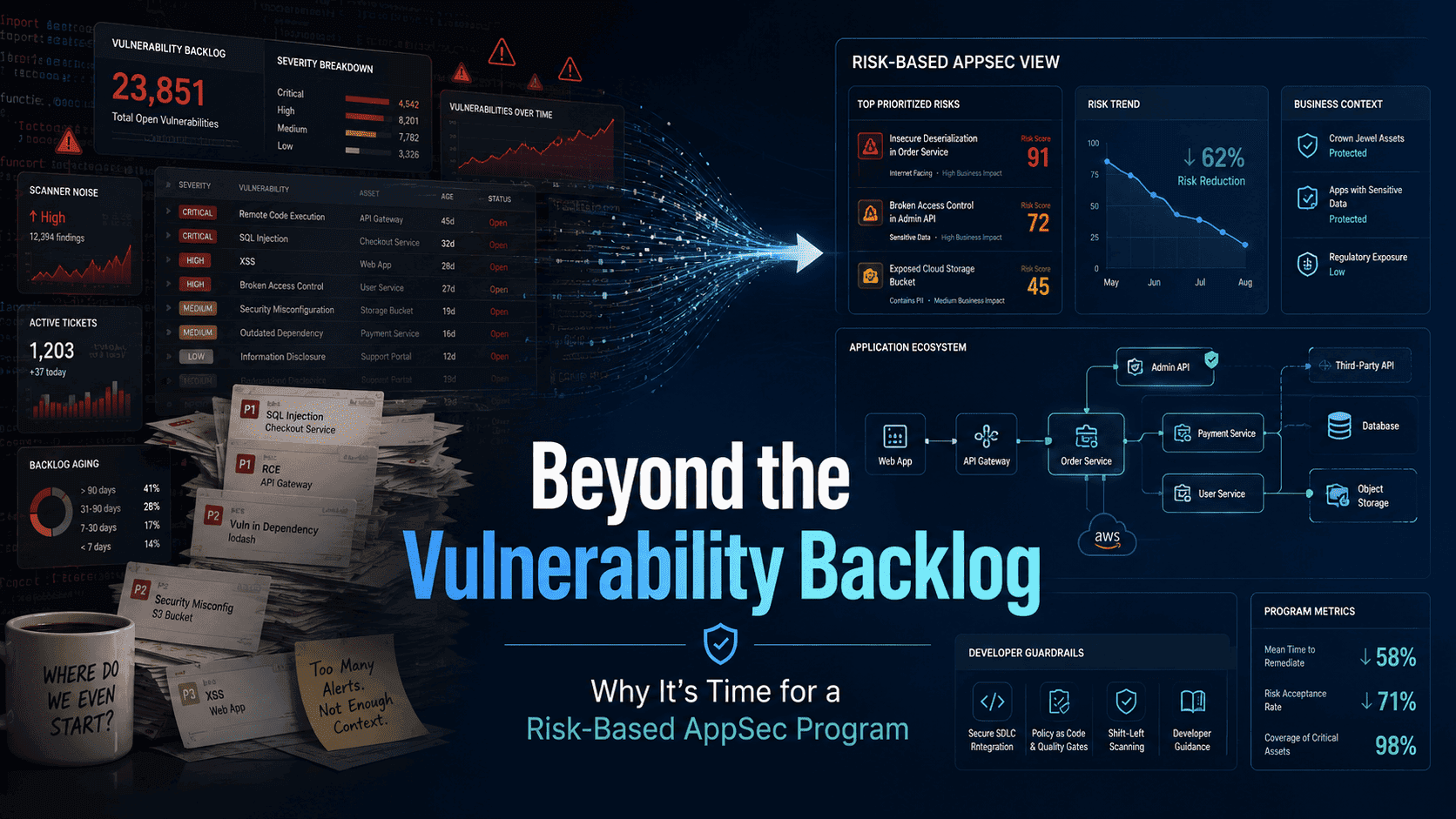
If you have ever opened a security dashboard and felt your stomach drop at the sheer number of red and yellow rows staring back at you, this post is for you. Modern application security has a backlog problem. Tools are firing, tickets are piling up, developers are tuning out, and nobody is sure which fix actually keeps the business safe. The fix is not a better scanner. The fix is a different way of looking at the work.
These notes come from reading Snyk's eBook Beyond the Vulnerability Backlog: Building Risk-Based AppSec Programs. I have written it as a beginner friendly walkthrough so anyone new to AppSec can follow along.
Terms Used Today
- AppSec (Application Security): The practice of finding, fixing, and preventing security issues in the software an organisation builds.
- SAST (Static Application Security Testing): A tool that scans source code for security flaws without running it.
- DAST (Dynamic Application Security Testing): A tool that pokes at a running application from the outside to find weaknesses.
- SCA (Software Composition Analysis): A tool that checks third-party libraries and open-source dependencies for known vulnerabilities.
- Vulnerability backlog: The growing list of unresolved security findings sitting in queues, dashboards, and tickets.
- Shift left: Moving security checks earlier in the development lifecycle, closer to when code is written.
- Guardrails: Lightweight rules built into the developer workflow that prevent risky changes without blocking everything.
- Asset: A concrete thing being built, deployed, or run. Code repositories, container images, branches, and third-party dependencies are all assets.
1. Why The Old Playbook Is Cracking:
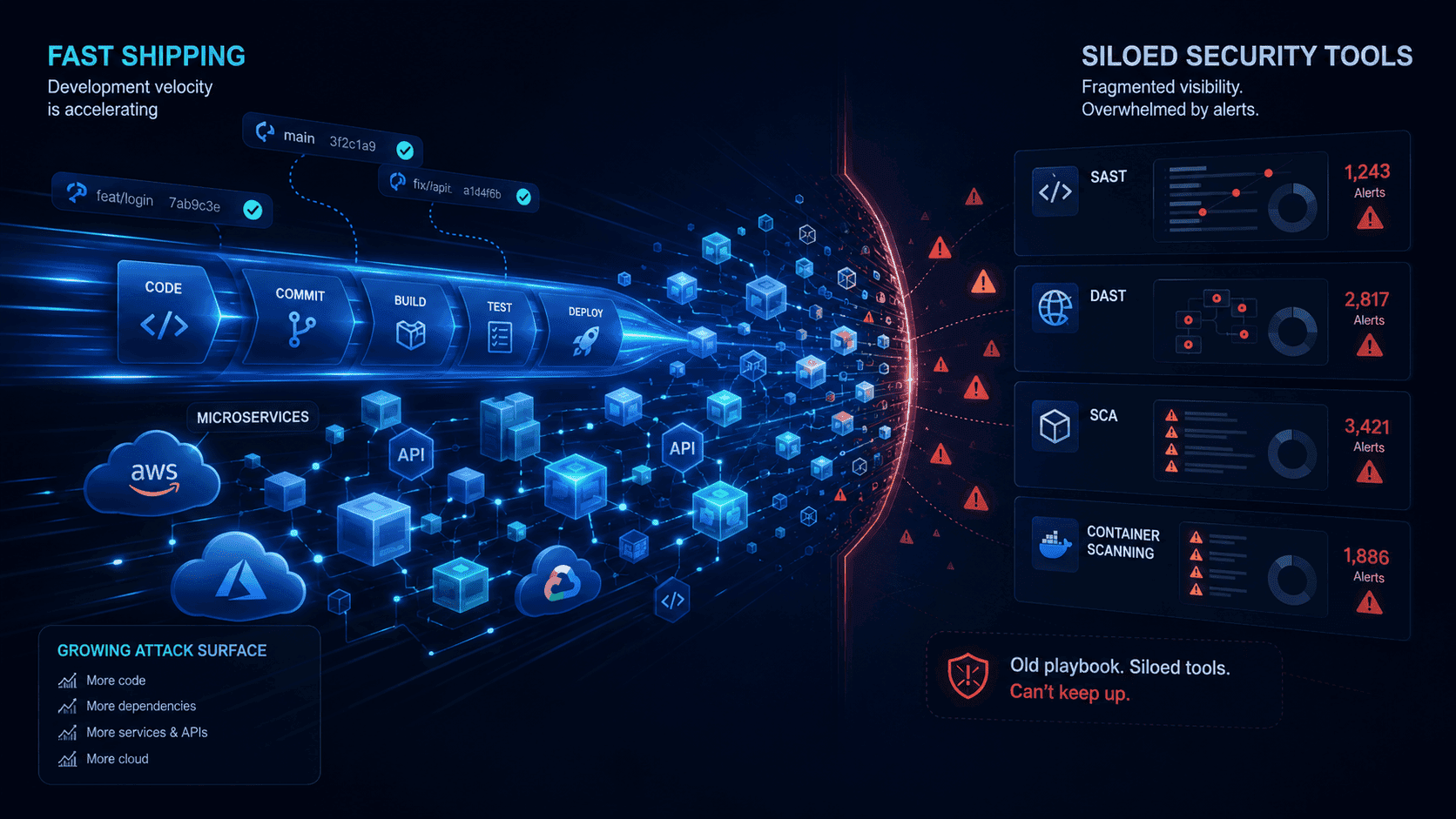
Software is shipping faster than ever. The eBook quotes a figure that 92% of organisations are seeing development velocity climb, powered by automated testing, smooth deployment pipelines, and AI-assisted coding. Features that used to take months now ship in days or even hours.
The problem is that applications are not getting simpler at the same speed. A modern app is a tangle of microservices, APIs, cloud services, and third-party packages. Every one of those moving parts is an attack surface. AI-suggested dependencies make that surface grow even faster, often without a human pausing to vet the package.
Meanwhile, the security tooling has stayed the same shape. SAST, DAST, SCA, container scanners. Each one looks at its own slice of the world and yells when it sees something. None of them know what the others know. None of them know whether the code they are flagging actually matters to the business.
2. What The Vulnerability Backlog Really Is:
The vulnerability backlog is the pile of findings that grows when those siloed tools run on a fast-moving codebase. It is not just a long list. It is a long list with no shared context.
A few reasons the backlog is so painful in practice:
- Wasted attention. Security teams spend more time triaging noise than dealing with the few findings that could actually hurt the business.
- Developer friction. A finding lands in a ticket with a CVSS score and no story. The developer has no idea whether this is a five-alarm fire or a low priority nag. Around 68% of developers say security slows them down.
- Bad prioritisation. Genuine zero-day threats get lost under thousands of older, lower-impact items.
- Slower releases. Without a way to tell critical from cosmetic, security teams put broad gates on every pull request, which slows everyone down.
For example, imagine a service that handles payment authentication. It has three issues that allow an attacker to bypass login. It also has fifty cross-site scripting findings spread across older, low-traffic dashboards. A traditional backlog will treat all of these as "high severity" and push them into the same queue. A risk-based view will tell you to drop everything and fix the three auth bypasses first.
3. Compound Risk and Why Shift Left Is Not Enough:
Modern risk does not sit inside a single file. It sits in the way things connect. A small vulnerability in a shared authentication library can compromise every service that imports it. An API misconfiguration can cascade across the dozen services that call it. A cloud setting can expose a perfectly secure app to the open internet.
This is what the eBook calls compound risk. You cannot judge a finding in isolation. You have to know what it is connected to.
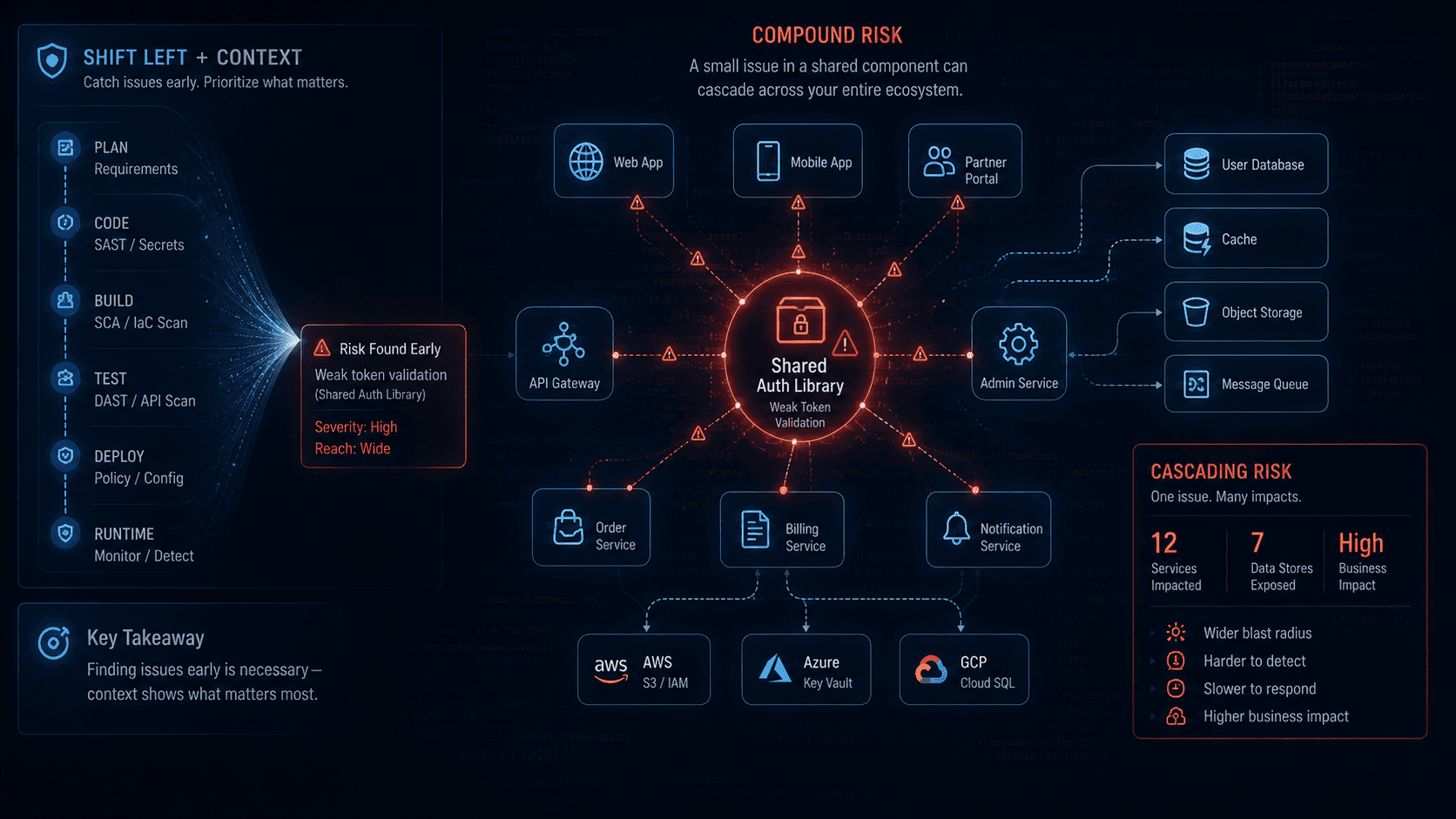
Shift left, the idea of running security checks earlier in the pipeline, is a real improvement and most teams have adopted it. The eBook says 91% of organisations have some shift-left programme. But less than half (46%) have a genuinely collaborative relationship between security and development. Catching a bug earlier is great. It still does not tell you which of the earlier bugs to fix first.
A small thought to sit with. Speed catches bugs sooner. Context tells you which bug is worth your morning.
4. The Risk-Based Paradigm In One Idea:
Here is the central shift the eBook is making.
A vulnerability is not a thing to patch. It is an indicator of risk to evaluate inside the context of the application and the business.
That single reframe changes a lot. Severity is no longer just a CVSS number. Priority is no longer first-in-first-out. Security stops being a department that says "no" and starts being a function that helps the business decide where to spend attention.
5. The Four Core Principles:
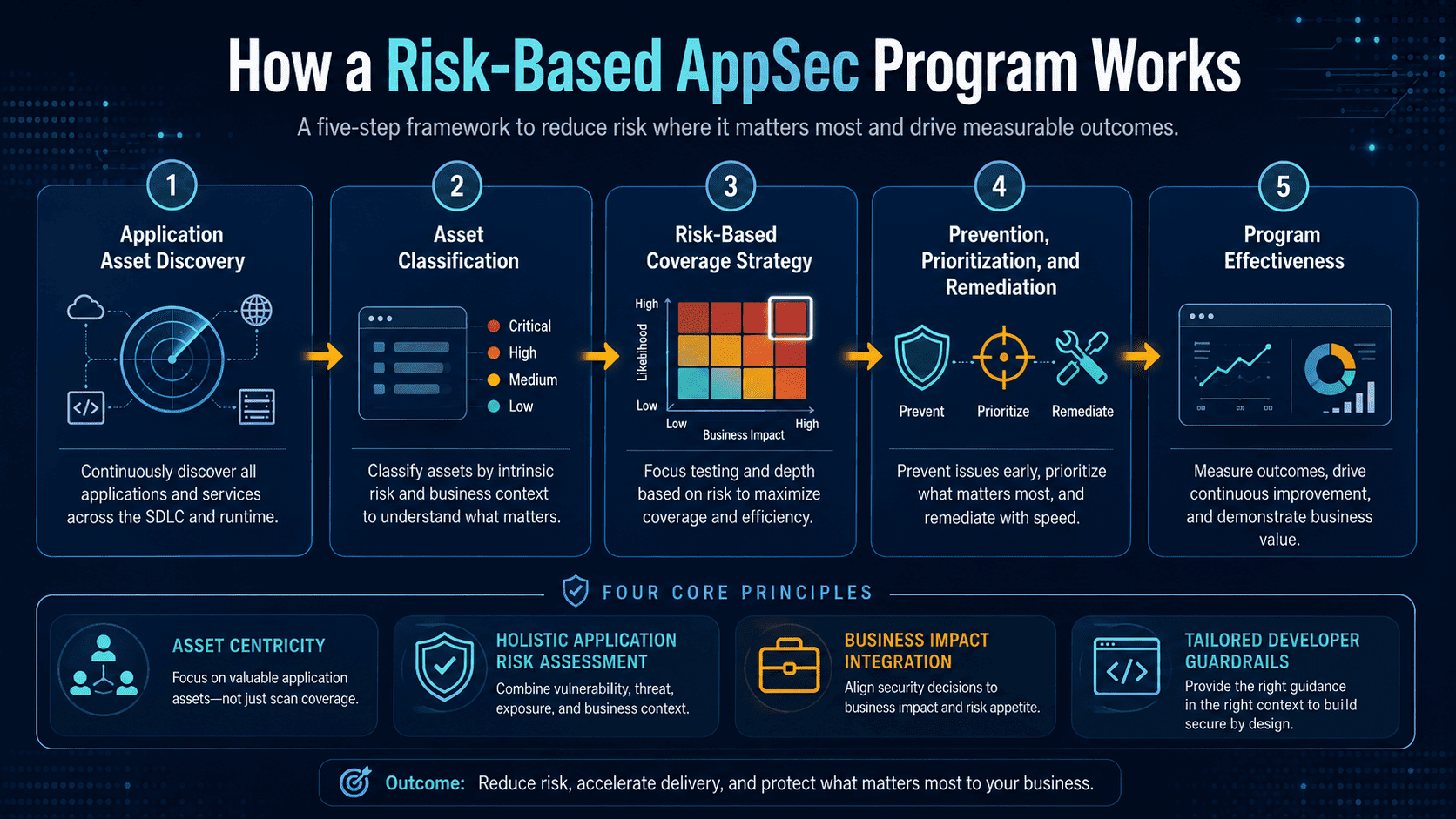
Risk-based AppSec sits on four principles. They build on each other in a sensible order.
- Asset centricity: Stop thinking in individual flaws. Start thinking in assets, the concrete things you build and run. Code repositories, container images, branches, and dependencies. A bug in your payment service repo is not the same as a bug in your internal demo repo, and the asset view makes that obvious.
- Holistic application risk assessment: Build a 360-degree view of each application from build time to runtime. That means knowing the architecture, the data flows, the deployment process, the controls already in place, and whether the vulnerability is actually reachable in production.
- Business impact integration: Score risk in business terms. Does this issue touch HIPAA data? Could it stop a revenue path? Is the affected service customer-facing? A medium severity bug in regulated data can outrank a high severity bug in an internal tool.
- Tailored developer guardrails: Stop applying the same security gate to every pull request. Let the rules adjust to the risk of the change. A README typo does not need a deep security review. A change to authentication logic does.
Put together, these four principles move you from reactive vulnerability management to proactive risk management.
6. The Five-Step Implementation Framework:
The eBook lays out a sensible order for getting there. You cannot skip steps because each one feeds the next.
- Application asset discovery. Map every asset from code to cloud, automatically and continuously. This is the foundation. You cannot protect what you cannot see. Pull from CI pipelines, developer portals, and service catalogues so the map stays current as the org ships.
- Asset classification. Sit with business stakeholders and label each application with what it does, what data it handles, who it serves, and what regulations apply. This is where you find out which apps are mission critical and which are mostly harmless.
- Risk-based coverage strategy. Different risk tiers get different security treatment. High-risk apps get the full set of scans, gates, and reviews. Lower-risk apps get a lighter touch. This is where you stop one-size-fits-all and start matching effort to importance.
- Risk-based prevention, prioritisation, and remediation. This is the day-to-day payoff. The system looks at a pull request and decides what security checks it actually needs based on the change, the affected systems, the data, the runtime exposure, and the controls already in place. A change to customer auth triggers the enhanced flow. A copy change does not.
- Program effectiveness. Measure success in things that matter. Risk reduction across the portfolio, coverage of critical assets, developer satisfaction, time to remediate real risks. Not raw vulnerability counts, which only tell you how loud your scanners are.
7. Traditional vs Risk-Based At A Glance:
The simplest way to feel the difference is to put the two approaches side by side.
- Focus: Traditional approaches focus on individual findings. Risk-based focuses on the risk profile of the whole asset.
- Severity: Traditional uses generic CVSS-style ratings. Risk-based contextualises the rating. A "medium" finding on HIPAA-regulated data may be lifted to critical.
- Tools: Traditional runs scanners in silos. Risk-based stitches SAST, SCA, and runtime data together to find what is actually exploitable.
- Gates: Traditional blocks every pull request that fails any check. Risk-based blocks only the changes that actually carry risk.
The traditional column is what most orgs are stuck in. The risk-based column is where the eBook is pointing.
8. What The Org Actually Gets Out Of It:
The benefits show up in three places.
- Better dev and sec collaboration. When findings carry business context, developers understand the why. They stop seeing security as a roadblock and start seeing it as a quality attribute. The eBook reports that 83% of developers are willing to secure their code when the tools do not slow them down.
- Strategic resource use. Limited security headcount goes to the most important assets first. Less time on noise, more time on what could actually hurt the business.
- Sustainable growth. As the portfolio grows, security work scales with risk rather than with raw line count. Less alert fatigue, more confidence that the real fires are being watched.
A small but important point. The biggest win is not the dashboard getting smaller. The biggest win is two teams that used to argue starting to speak the same language.
9. Questions to remember before closing:
- What is a vulnerability backlog? The long pile of unresolved security findings that builds up when fast development meets siloed, context-free scanners.
- Why do traditional AppSec tools fall short on modern apps? They each look at one slice (code, dependencies, container, runtime) and report without knowing what the others found or what matters to the business.
- What does "risk-based AppSec" mean in one line? Treat a vulnerability as an indicator of risk to evaluate inside business context, not just a flaw to patch.
- Name the four principles. Asset centricity, holistic application risk assessment, business impact integration, tailored developer guardrails.
- Walk through the five-step framework. Asset discovery, asset classification, risk-based coverage strategy, risk-based prevention and remediation, program effectiveness.
- Why is shift left alone not enough? It catches bugs earlier but does not tell you which bug matters most. You still need context and prioritisation.
- What is compound risk? Risk that emerges from how components connect. A small flaw in a shared library or a single misconfiguration can cascade across many services.
- What metrics show a risk-based program is working? Risk reduction across the portfolio, coverage of critical assets, developer satisfaction and velocity, time to remediate real risks. Not raw vulnerability counts.
10. Summing It Up:
If we remember one thing from today, it is this: a vulnerability backlog is a symptom, not a problem. The real problem is doing security without business context. Risk-based AppSec swaps "fix everything" for "fix what actually matters to the business," and the side effect is a healthier relationship between developers and security teams.
The path is not glamorous. Discover your assets, classify them with the business, match controls to risk tier, let the workflow adjust to risk on the fly, and measure things that actually move the needle. Done in order, that is what gets an organisation past the backlog and into security that travels at the speed of the business.
That's all for today. Thanks for reading.
Cheers!